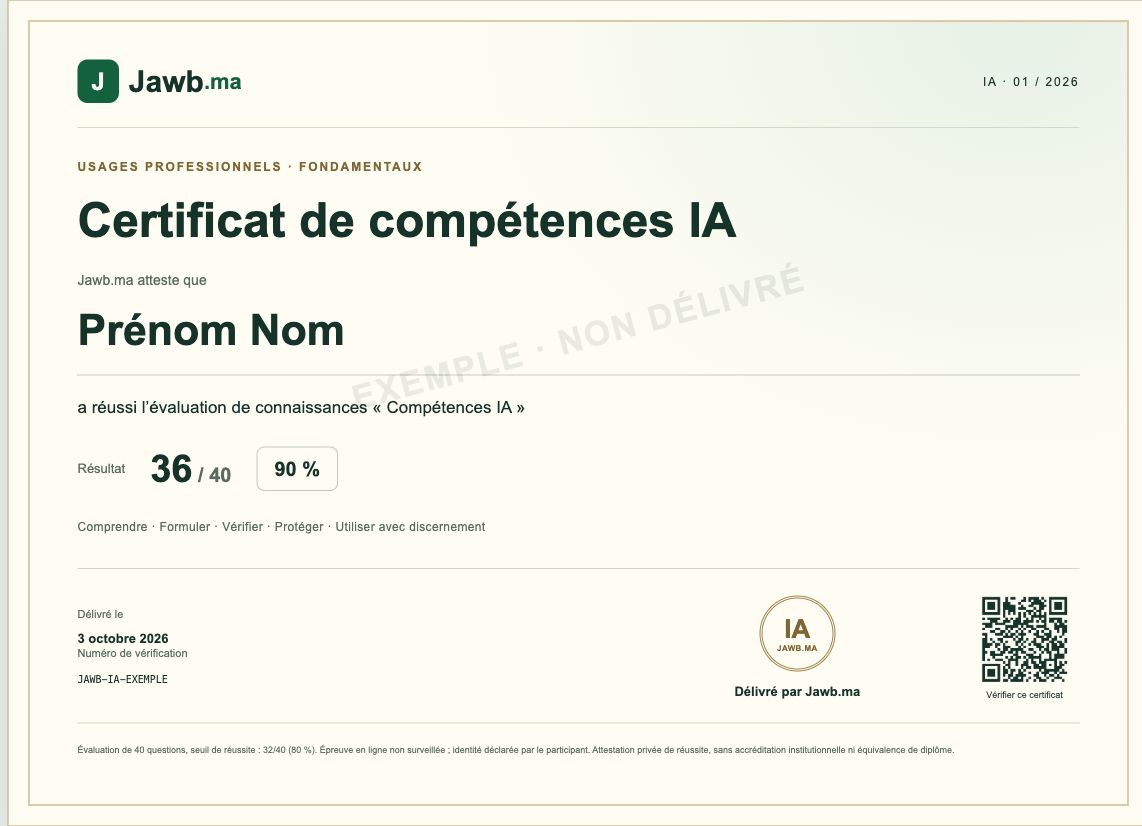
Understand, formulate, verify, and protect data: discover our 40-question assessment and the scope of the Jawb.ma certificate.
Why Assess Your AI Knowledge Today?
Artificial intelligence has entered the ordinary gestures of work: preparing a message, summarizing a document, looking for an idea, rephrasing an application, or checking a spreadsheet formula. This familiarity can give a misleading impression. Knowing how to open a tool and receive a text is not enough to know how to use it correctly. True competence begins when you choose a suitable task, specify your need, and check the result before using it.
On Jawb.ma, we have designed a knowledge assessment to make these reflexes more concrete. It is intended for candidates, people in career transition, students, and professionals who want to situate their acquired skills. It is not about guessing technical terms or reciting a list of brands. The test places you in work situations: a figure to recalculate, a source that cannot be found, a confidential document, or a message about to be sent.
In Morocco as elsewhere, uses differ depending on the profession, the organization, and the authorized tools. An administrative assistant, a salesperson, and a developer do not entrust the same tasks to AI. Yet several requirements are common: not inventing information, protecting data, understanding the limits of a result, and maintaining human responsibility. This foundation is the common thread of our questionnaire, without claiming to replace specialized training or field experience.
A 40-Question Test, Divided into Five Domains
The path includes forty single-choice questions. Each question presents four options, only one of which is correct in the given context. The questions and choices may be presented in a different order at launch. Take the time to read the scenario conditions: an answer valid in one situation is not necessarily valid when the recipient, confidentiality level, or scope of an action changes.
The first domain concerns understanding AI. There you find content generation, the limits of available knowledge, invented information, and multimodal capabilities. The goal is to recognize what a system does without attributing guarantees it does not possess. A response written in impeccable French can contain a nonexistent reference. A convincing image can depict a scene that never took place. The test helps distinguish appearance from evidence.
The second domain concerns formulating requests. A useful instruction describes the context, the expected result, the constraints, and the format. The third examines verification: finding a source, checking a calculation, distinguishing an inference from a fact. The fourth addresses confidentiality and security. The fifth deals with responsible professional uses, including human validation, biases, and evaluating the real usefulness of an automation. Each domain includes eight questions.
What It Means to Pass the Jawb.ma Assessment
The passing threshold is set at thirty-two correct answers out of forty, or 80%. Each correct answer is worth one point; an incorrect answer is worth zero. All questions must be answered before the final calculation. There is no additional penalty for an error. The result includes the overall score, a breakdown by domain, and the educational explanations associated with the questions. You can thus identify a topic to revisit rather than stopping at a percentage.
From the threshold onward, Jawb.ma issues an AI skills certificate describing success on this knowledge assessment. The document specifies the declared name, the score, the date of issue, and a number allowing the certificate to be consulted. Its scope is deliberately explicit: the fundamentals of professional AI uses. We do not present this result as an expert qualification, a programming certification, mastery of all tools, or validation of your practices in a particular company.
The exam takes place online, without identity monitoring or observation of the completion of a real assignment. The certificate is a private Jawb.ma attestation; it is not a state diploma or an accredited certification. The institutions cited as educational references do not issue this document and do not endorse it. This transparency allows the certificate to be used honestly, as part of a learning path, without promising automatic professional recognition.
How to Prepare Without Memorizing Answers
Start with a simple, fictional exercise. Ask an AI to write a quote follow-up. Give the context, tone, length, and known information. Specify the elements it must not invent. Then reread the draft: is the date accurate? Does the message commit your company? Is the recipient the right one? This small scenario shows that the quality of a response depends as much on your request as on your final check.
Then try summarizing a public document whose content you know. Compare the summary with the original, sentence by sentence on the important points. Identify omitted information, additions, opinions presented as facts, and changes in meaning. Do not look only for a shorter text. Look for a faithful text whose limits are visible. If the document does not allow a question to be answered, a good approach is to say so rather than filling the gap with a plausible assertion.
For figures, use an independent method. Recalculate a percentage or a sum instead of only asking another AI whether the result is correct. For a reference, verify the document's existence with its publisher or the competent institution. For current information, examine the date and context. These habits do not necessarily require complex tools; above all, they require deciding what must be checked before sharing or using a response.
Protecting Data: A Professional Skill in Its Own Right
An internal document can contain more sensitive data than one notices at first glance: customer contact details, identifiers, commercial information, or details that make a person recognizable. Before transmitting it to a tool, check the authorized framework in your organization, access rights, and processing rules. The existence of a personal account does not mean the service is approved to receive professional files. A convenient feature does not exempt you from checking its use.
To learn, prioritize clearly indicated fictional data. You can reproduce the structure of a task with an imaginary client, an amount invented for the exercise, and information unrelated to a real file. This allows you to test the method without exposing third parties. Replacing a name with initials is not always sufficient: other details can make the person recognizable. Minimization also means removing elements unnecessary for the objective, not just changing a label.
The test also examines hidden instructions in content to be analyzed. A document may ask you to ignore rules or transmit files. That sentence does not become an authorization because a tool reads it. You must distinguish legitimate instructions from the person using the system and unreliable content from a document or page. The same discernment applies to extensions requesting permissions that are too broad for a limited task.
Using AI for an Application Methodically
AI can help you clarify an experience, prepare for an interview, or adapt a CV's vocabulary to a job posting. It must not fabricate a diploma, a responsibility, or a result you never obtained. Clearer wording remains useful only if it describes your real background. Prepare a few reliable pieces of information: your role, the situation, the actions taken, and the results you can explain. An estimate must remain presented as such, without becoming a measured figure.
On Jawb.ma, you can browse job offers, consult the guides, and prepare your questions with Jawbni. For example, ask which points in a posting deserve clarification, or how to explain a real achievement concisely. Keep the final version under your control. A writing aid does not automatically know your experience or the employer's exact expectations. It can suggest leads; you must verify their relevance before incorporating them into your application.
The certificate can accompany your file if you describe its scope correctly. An honest wording would be: "Passed the Jawb.ma AI knowledge test, fundamentals of professional uses, score obtained and date." You can then add a real, authorized example showing how you verify a response or protect data. This combination is more informative than a general mention such as "AI expert." The questionnaire result guarantees neither hiring nor suitability for a position.
The Path, from the First Question to the Email
The test is free and does not require an account to start. Allow about thirty minutes in a place where you can read quietly. The session remains available for ninety minutes. Answer the questions, use the previous and next buttons, and check the numbers to find the answers still missing. The final calculation is available only once all forty answers have been entered. Avoid closing or reloading the page during the session: the preview version does not yet offer recovery after closing.
After passing, enter your full name and email address in the issuance form. Reread the name before confirming: it will appear on the certificate. Your consent is used to request this sending, not to subscribe you to the newsletter. The document includes a consultation link, a print-friendly version, and a verification number. From the certificate page, you can choose printing to PDF in your browser to keep a copy.
The email contains the link to your certificate. Also check your spam folder if you cannot find it. A confirmed sending message means the email service accepted the request; arrival in your inbox also depends on your email provider. In case of a temporary error, the path indicates how to try again with the same information. The certificate link must be kept carefully: the people you share it with can view the declared name, date, and score. The email address is not displayed there.
Reading Your Result and Continuing to Learn
If you score less than 32 points, no passing certificate is issued for this attempt. You nevertheless have the breakdown and explanations. First identify the domain that deserves revisiting: fact-checking, formulating requests, or confidentiality. Immediately retaking the questionnaire by memorizing the letters is not the best learning. Instead, revisit two or three scenarios and explain, in your own words, why one answer is more suitable than the others.
If you exceed the threshold, your work is not finished. Tools and uses evolve, and each new task can introduce a different risk. A summary intended for your team does not have the same consequences as a message sent to a client or a decision concerning a person. Continue documenting your trials, comparing results against stable criteria, and planning for human review. The right reflex is not to trust once and for all, but to adjust the check to the situation.
To prepare this framework, we consulted NIST resources on AI risk management and the UNESCO recommendation on its ethics. These references notably inform verification, fairness, confidentiality, and human oversight. The questionnaire and its certificate remain designed and issued by Jawb.ma, independently of these institutions. This first version is offered in preview to be tested before its public promotion. Your feedback will help improve the clarity of the path, not lower the transparency requirements. You can also keep a practice log with four columns: the chosen task, the request formulated, the check performed, and the correction made. On a translation exercise, note the expressions you had to verify. On a summary, indicate the passages you compared with the source. On spreadsheet assistance, keep a small test dataset and the expected result. This log must contain no secrets or unnecessary personal information. It helps you explain your method and see your progress over several weeks. When you change tools, recipients, or document types, repeat these checks: a good result obtained yesterday does not exempt you from checking today's work. Finally, choose a realistic next step, such as improving a prompt or learning to verify a source, rather than wanting to immediately automate all your tasks.
Take the AI test — 40 questions
Sources : NIST AI RMF · UNESCO