
Average salary and minimum thresholds
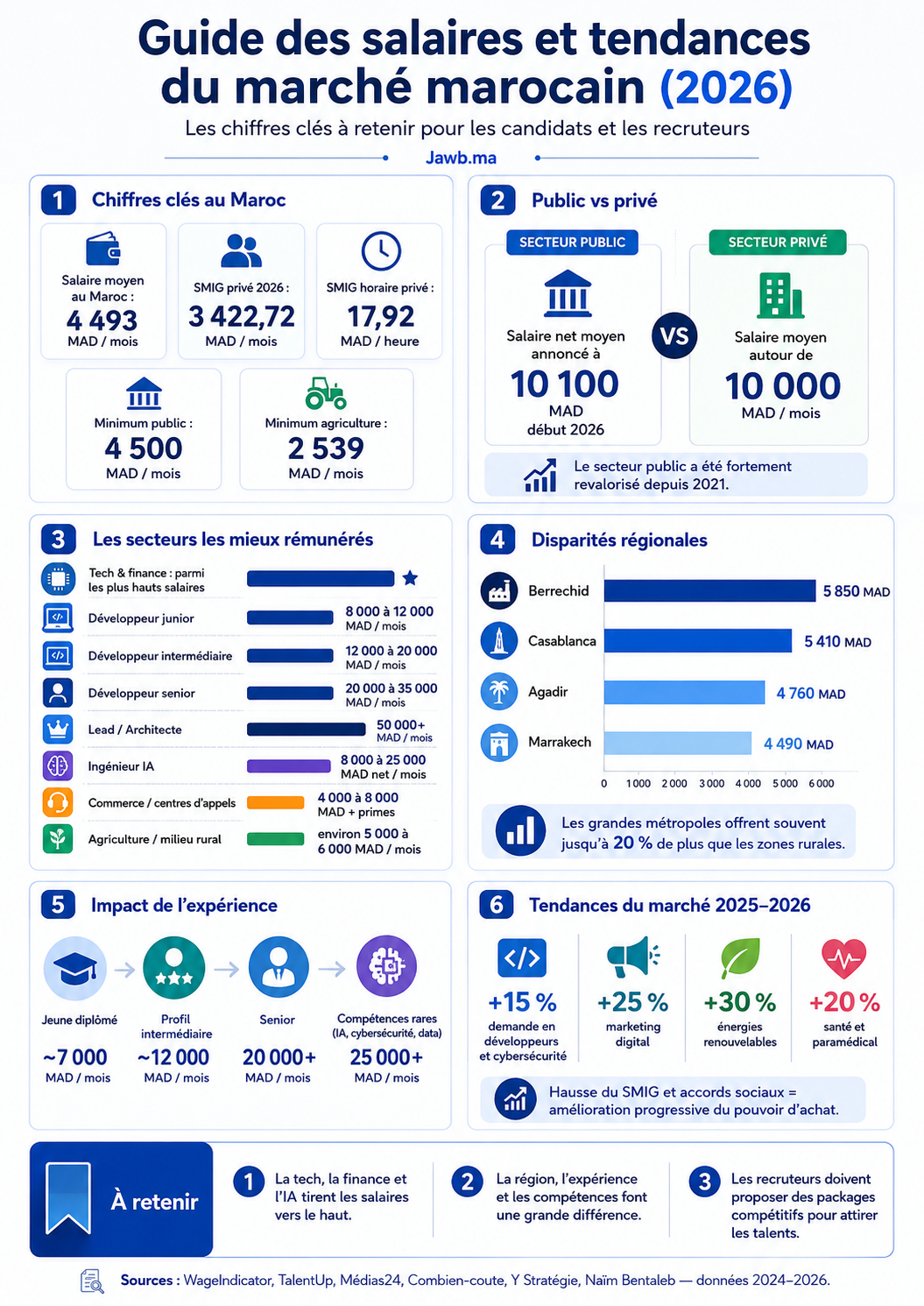
The overall figures set the tone. The average salary in Morocco in 2026 is around 4 493 MAD per month (approximately 420 EUR). The platform also indicates a significant gap between major cities and rural regions: Casablanca shows an average salary equivalent to 541 EUR per month, while cities such as Al Hoceima or Tata are around 280 EUR.
At the legislative level, the guaranteed interprofessional minimum wage (SMIG) was raised in 2026:
- 3 422,72 MAD/month in the private sector (i.e. 17,92 MAD per hour)
- 4 500 MAD/month in the public sector
- 2 539 MAD/month in agriculture
These floors form the basis of the salary grids used by companies.
Public versus private: a persistent gap
In the civil service, the government announced a significant increase in pay. The average net salary of civil servants rises from 8 237 MAD in 2021 to 10 100 MAD in early 2026. The minimum net salary in the public sector, which remained at 3 000 MAD for several years, has been raised to 4 500 MAD. Sectoral agreements have also led to targeted increases (for example, a general increase of 1 500 MAD for more than 330,000 employees of the national education system).
The gap with the private sector remains tangible. The average salary in the private sector is around 10 000 MAD/month, approximately 20% more than the public sector. This difference is explained by the dynamism of international companies established in Casablanca, Tangier and Rabat.
Variations by sector: where do you earn the most?
Finance and information technology
The finance and information technology sectors remain the best paid. A software engineer in Marrakech can earn around 20 000 MAD/month, while a farmer in a rural region receives around 6 000 MAD.
Detailed ranges for developers:
| Level | Annual salary | Monthly salary |
|---|---|---|
| Junior (0-2 years) | 96 000 - 144 000 MAD | 8 000 - 12 000 MAD |
| Intermediate (2-5 years) | 144 000 - 240 000 MAD | 12 000 - 20 000 MAD |
| Senior (5+ years) | 240 000 - 420 000 MAD | 20 000 - 35 000 MAD |
| Lead/Architect | Up to 600 000 MAD | 50 000+ MAD |
Specialised roles (AI, DevOps, data engineering) start at around 180 000 MAD/year and can exceed 480 000 MAD/year.
Artificial intelligence
An AI engineer earns between 8 000 and 25 000 MAD net per month:
- Junior: 8 000 - 12 000 MAD
- Intermediate: 12 000 - 18 000 MAD
- Senior: 20 000 - 25 000 MAD
The banking and insurance sectors offer the highest pay.
Commerce, tourism and services
Employees in the hotel and retail sector receive around 150 000 MAD/year (i.e. 12 500 MAD gross per month). In call centres and sales roles, base salaries range between 4 000 MAD and 8 000 MAD, to which performance-based variable bonuses are added.
Agriculture and the primary sector
Agricultural occupations remain among the least well paid. In rural areas, the average monthly salary remains close to 5 000 MAD.
Regional disparities
The gaps are not limited to sectors: location plays a decisive role.
| City | Average monthly salary |
|---|---|
| Casablanca | ~12 000 MAD (major city) / 5 410 MAD (all sectors) |
| Rabat | ~10 000 MAD |
| Berrechid | 5 850 MAD |
| Agadir | 4 760 MAD |
| Marrakech | 4 490 MAD |
In major cities (Casablanca, Rabat, Tangier), the concentration of multinational companies and startups drives salaries up. The average salary in Casablanca is 20% higher than in rural regions.
Impact of experience, education and skills
Seniority and level of education strongly influence pay:
- Recent graduate: around 7 000 MAD/month
- Intermediate: 12 000 MAD/month
- Senior: 20 000+ MAD/month
Holders of master's or doctoral degrees and those with sought-after skills (data analysis, cybersecurity, AI) can expect salaries above 25 000 MAD.
Job market trends (2025-2026)
The outlook for 2026 is marked by several trends:
Growth of digital: demand for digital skills is exploding. 15% growth in demand for developers and cybersecurity experts. Digital marketing specialists will see demand increase by 25%.
Renewable energy and green industry: renewable energy engineers benefit from an expanding market, with a projected 30% increase in recruitment.
Health and paramedical: needs are expected to grow by 20%, with salaries between 8 000 and 15 000 MAD depending on the specialty.
Increase in the SMIG and social agreements: the 20% increase in the SMIG in the private sector and the agreements concluded with the unions will gradually improve purchasing power.
Universalisation of social protection: the direct social assistance and housing assistance programmes put in place in 2024-2025 should reduce inequalities.
Advice for recruiters
- Adapt your offers: aligning the salary grid with market averages is essential to attract talent
- Highlight the benefits: beyond salary, offer remote work, meal vouchers, health insurance
- Internal training: invest in skills development (cloud certifications, AI, languages)
- Transparency and fairness: communicate clearly about your salary grids and promotion criteria
Advice for candidates
- Research the market: compare your profile with the data in this guide before negotiating
- Develop your skills: web development, professional English, data analysis or cybersecurity significantly increase your value
- Consider location: working in Casablanca or Rabat offers higher salaries but a higher cost of living. Remote positions sometimes allow you to stay in your region
- Think long term: a position with good management and prospects for advancement can be more advantageous than an attractive salary with no support
Conclusion
The Moroccan job market is undergoing profound change. Salaries vary widely depending on sector, experience and location. The data show a rise in the power of technology and artificial intelligence occupations. The gradual increase in the SMIG and social reforms are improving conditions, but the key remains agility: anticipating trends, investing in skills and negotiating with full knowledge of the facts.
With this guide, Jawb.ma aims to give Moroccan professionals the benchmarks they need to progress with confidence and contribute to a more transparent and fair labour market.